the meta.
Phase 1: Foundation

Tech and I grew up together. My dad was a theoretical physicist at Lawrence Berkeley Labs in the early ’80s, back when computation came on punch cards that he’d bring home for me and my brother to play with. We had an Apple II at home, and I was the girl teaching my first-grade classmates how to load Hangman from a cassette and write a few lines of BASIC to load it. Once, my mom took me to my dad’s lab so I could watch a message arrive from him in Germany — green text blinking across a black screen. The baby internet.
I studied computer science and AI at the University of Chicago in the mid-’90s, but I always found programming itself frustrating, mostly because I just wasn’t great at it. LISP was elegant and maneuverable; C++ was unforgiving. I hated having to load and link endless libraries just to get an environment to compile without throwing an error. I experimented with neural nets and case-based reasoning systems, but working in that build environment was brutal if you weren’t a hardcore coder — especially at UChicago, where some of my friends were writing in assembly for fun.
Then Mosaic appeared, and later Netscape Navigator. I started doing web development work because the new tools made creation feel suddenly accessible — like anyone could build something and share it with the world overnight.
That experience of speed and autonomy made me curious about what happens when technology scales in large organizations. I went back to the University of Chicago for an MBA in tech strategy, then joined Deloitte as a tech project manager, stepping into a world where progress depended on alignment, governance, and process.
Eventually, I worked directly with Fortune 100 CIOs as they transitioned into their roles and saw firsthand how the job was not about technology itself and more about orchestration — aligning people, priorities, and expectations across sprawling systems. The real constraint was coordination at scale.
When I left Deloitte to raise four children, the same patterns emerged — constant coordination, shifting priorities, limited time. Just at a more intimate scale.
I became the director of the Žiburio Lithuanian Heritage School, founded by families who escaped Soviet occupation after World War II and built it from nothing so their children would not lose their language or connection to their cultural inheritance. Managing volunteers, teachers, and children required the same systems logic — alignment, continuity, and care — but applied to identity.
Technology, community, family — they’re all transmission systems, ways of preserving what matters and passing it forward. That became the foundation for eternal360.
In the beginning, I thought I’d build eternal360 using some combination of vibe coding or no-code platforms. But with the newest generation of AI models — Claude Code, Claude Sonnet 4.5, and GPT-5 — the distance between idea and execution has collapsed. I no longer need a no-code layer to translate intention into product. I can build directly.
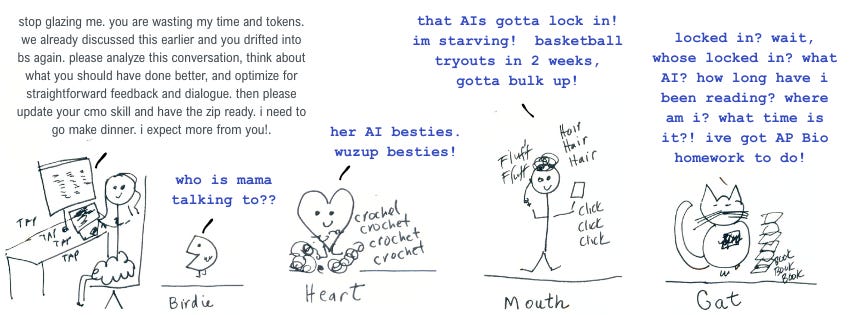
I’m a solo founder, but not really alone. I work with a structured team of AI collaborators — each one specialized, contextual, and integrated. ChatGPT runs research and exploration. Claude is my executive team — CTO, CMO, CSO, and product lead — carrying context across every part of the build. Claude Code takes specs and ships production code. They’re all wired together through connected knowledge bases and task systems.
When I need to validate a product decision, I ask Claude to surface our Linear sprint plan, cross-reference the tech stack doc that Claude Code updates constantly, and check if the feature supports our permanence principle. Then I hand the spec to Claude Code, which analyzes it in plan mode, refines the spec, gives me its expert opinion based on the engineering skills we developed together, and works with me to build it. And this is all while sitting in the car waiting to pick up my son from basketball practice.
I’m building with AI because it’s structurally better and expands what’s possible for a solo founder. The constraint isn’t time or technical ability anymore.
The AIs are my true creative partners. Each model has its own temperament: ChatGPT - exploratory, Claude - analytical, Claude Code - relentless. Together, they form a system that learns through interaction. I refine that system constantly — tuning skills, shaping context, and adjusting the framework that guides how we build.
Intelligence isn’t just a possession; it’s a relationship — something cultivated through context, iteration, and care. It grows the same way human intelligence does: through attention, feedback, and the slow accumulation of meaning. It’s the same principle that shapes how I raise my children — giving them context for life so they understand what matters, and where to focus their energy.
And that’s what building eternal360 is all about.